|
 |
|
"Prof.
Albert Einstein on board of his sailing boat
which he was given by friends.
(photograph: A.Harms) |
20-m²-sailing
boat for professor Albert Einstein
Of the three owners of the "Berliner
Handelsgesellschaft" (Berlin Trading Company) it was the
ship-building engineer Adolf Harms who received the
honourable order to design a boat as present for the
famous scientist Albert Einstein's 50th birthday.
They
agreed on a sailing boat with auxiliary engine and a
sailing area that should be kept as small as possible.
Furthermore it was required that the operation of the
sailing boat would be easy and not exhausting.
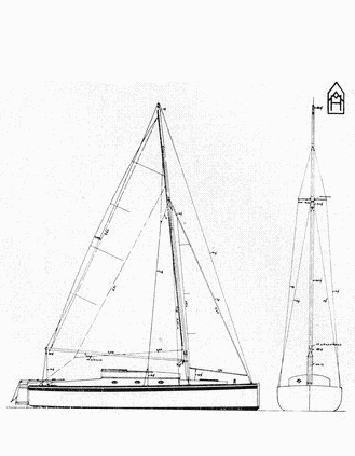
The draft
next to this text was developed from these
prerequisites. The draft was built at the shipyard of
Berkholz & Gärsch under supervision of the designer. In
summer it was delivered to Albert Einstein who was
completely satisfied with it.
The
engine should be equipped with a starting motor and a
generator. If possible it should not be seen anywhere in
the sailing boat. Thus the designer made the proposal
that a slightly bigger freeboard was used, which made it
possible to lay the floor in the cockpit so high that
the engine could be placed completely beneath it; at the
same time the cabin construction could be kept
relatively low.
Contrary
to the original equipment the sailing boat was equipped
with a bathroom whose place is visible from the cover.
An originally intended buffet had therefore to be left
out; it was replaced by a smaller shelf for glasses and
a shelf for three shag pipes.
One
additional remark has to be made concerning the
equipment that is mainly visible from the drafts: both
cupboards under the side deck at port and starboard were
enlarged for 4 persons to accommodate cups, plates etc.
All the necessary cutlery, washing bowls, brushes,
leather cloth etc were delivered with the cupboards for
the sailing boat to be completely ready for use.
The space
under the afterdeck can be locked and serves as freight
hold for fender, bucket, spare petrol can and other
similar things.
|
 |
|
20–m²-sailing boat, draft
– cover for the bathroom
|
|
 |
|
20-m²-sailing
boat. Designed by ship-building engineer
Adolf Harms. Construction and equipment
draft. Total length 7,00 m, molded breadth
2,35 m, draught 0,33 m, draught with counter
blade 1,25 m, engine: 2 cyl. F.-Z. 5/6 hp,
light, starter. |
In the
cabin at port there is a sideboard built in, in which a
spirit stove with zinc plate bowl is arranged in such a
way that it becomes visible when moving the upper plate
of the sideboard and is ready for use. When the spirit
stove is not needed it is not visible at all.
The
engine, a 2-cylinder-two-stroke 5/6 hp F.Z., was built
in such a fashion that it is absolutely heat resistant.
This was achieved by insulating it to all sides. The
walls of the bulkhead were lined with asbestos and sheet
metal so that the fuel tank, which was arranged at port
next to it, is completely separated from the engine. The
generator and the starting motor are situated in the
engine compartment.
The
engine is accessible very easily after removing the
planks, which are also heat-resistant from underneath.
The lever for the reversible propeller which can be
feathered is removable so that it disappears completely
when sailing; the necessary slot is closed by a copper
plate. The planks are built in such a fashion that the
engine can not get wet when it rains.
The
engine has proved of value at the crossover from east to
west, it sailed perfectly.
The cabin
contains two comfortable sleeping places with blue
covers, whose colour matches very well with the mahogany
of the interior decoration.
|
 |
|
20-m²-sailing boat.
Sketch of the sails. Main sail 16,05
m²- , fore sail
3,95 m²-, lug sail 8,25 m² |
The cabin
roof consists of two layers of wood with an interim
layer of water-tight canvas. The lower layer consists of
maple wood, which together with the threefold glued
planks out of mahogany gives a good composition of
colours. The upper layer consists of pure mahogany.
At port
there is a roomy wardrobe. Next to it is a small
wardrobe which serves for accommodating removable
electric position lamps.
The
sailing boat has proved its value under all wind
conditions from about 0 to 10 m/sec when all sails are
set and sails very well, even with the high weight of
the sails. This is also true for sailing at lull.
It was a
special wish of professor Albert Einstein that the
sailing boat was equipped with a Bermuda rig. To
facilitate the setting of the mast, the bibs are
situated that high that the boom could be mounted on a
pivot and furthermore it was obtained that the lower end
of the mast situated in the bibs could become about 1,15
m long and could be equipped with a lead weight at the
lower end corresponding to the weight of the mast. Thus
an easy setting of the mast could be achieved.
|
 |
|
Prof Albert Einstein with
his sailing boat "Tümmler" shortly before
launching." |
|
Albert Einstein
was very content with his sailing boat. In the autumn of 1929 he
wrote in a letter to the ship-building engineer Adolf Harms:"…The
sailing boat has my highest respect and also the respect of all
the people who have been sailing with it. It combines a high
degree of stability with a relatively high mobility and comfort
for the operation."
Rudolf Kayser,
the husband of Einstein’s stepdaughter Ilse wrote in his
Einstein biography under the pseudonym Anton Reiser in 1930:
"While his hand holds the rudder Einstein explains with joy his
latest scientific ideas to his present friends. He sails the
boat with the skill and fearlessness of a child. He himself
hoists the sails, climbs around on the sailing boat to tighten
the tows and ropes and handles bars and hooks to set sails. The
joy with this hobby can be seen in his face, it echoes in his
words and in his happy smile."
But the joy with
his sailing boat was not to last very long.
After the
national socialists seized power in January 1933 - when Albert
Einstein stayed in America - his complete property was
"confiscated by the national socialists and kept in favour of
the Prussian state", also his beloved "thick sailing boat".
To be precise,
Einstein’s sailing boat was confiscated twice – first by the
Prussian state and then by the Gestapo.
Einstein had
still tried to save his sailing boat from the access of the
Gestapo in the last minute by asking Hermann Schumann to take
his sailing boat to the Netherlands where it would be safe
because the anchorage of Einstein’s sailing boat was in Hermann
Schumann’s shipyard in Potsdamer Strasse. As such an action held
danger, Schumann didn’t give in to Einstein’s wish.
The seizure of
the sailing boat by the police was executed on June, 12 in 1933.
The following announcement could already be read in the
Vossiche Zeitung on the same day:
|
"Einstein’s
speed motor boat confiscated. The speed motor boat
of professor Einstein which was moored at a shipyard
in Caputh near Potsdam was confiscated and seized
for the Reich. Einstein is said to have planned to
smuggle the sailing boat into a foreign country. The
sailing boat is worth RM (Reichsmark) 25,000." |
It is fascinating
that Einstein’s sailing boat was transformed into a speed motor
boat and the stated value of the sailing boat in the
announcement was higher than the value as new.
Though he did not
think of a success, Einstein had - for reasons of precaution -
authorized his son in law Rudolf Kayser to act for him to
prevent a possible seizure of his possessions, but it was in
vain.
In January 1934
it was ordered that the sailing boat was to be sold if the
police did not see any kind of use. When selling the sailing
boat, however, it should be prevented "that the sailing boat was
once again bought by public enemies."
In the
Potsdamer Tageszeitung Einstein’s "Tümmler" was announced
for sale on February 28 in 1934.
|
"Sailing
boat with starter motor, additional equipment,
immediately, massively built of mahogany, in good
condition, 20 m² sails, moors Caputh, Potsdamer
Straße 27. Offers to the local government of Caputh
up to March, 8." |
The first offer
of RM 1200 came at the beginning of March from the dentist Dr.
Wilhelm Fiebig from Nowawes near Potsdam. In contrast to the
following two offers - a man from Potsdam offered RM 600 and a
doctor from Berlin was ready to pay RM 1000 to RM 1200 - the
offer from Dr. Fiebig was not signed with "Heil Hitler".
After the period
of time stated in the announcement had expired, the sports club
of the Reichsbahn wanted to buy the sailing boat. It should
serve there for training the young generation. The club offered
RM 1300. Dr. Fiebig successfully fought this offer and increased
his offer also to RM 1300. In May 1934 Einstein’s beloved "thick
sailing boat" was sold to Dr. Fiebig for a price of RM 1300.
In 1945 Einstein
asked the community of Caputh in a letter from the far away
America for the whereabouts of his property, among other things
also for the remaining of his "thick sailing boat". The
community officially investigated the whereabouts of the sailing
boat, but the investigation was not successful. The trail of the
sailing boat could only be followed until the end of the 30ies.
What happened to the sailing boat after that time up to now and
its whereabouts are unknown.
Illustrations Credits:
Courtesy of the magazine "Die Yacht".

MODEL OF
EINSTEIN’S „TÜMMLER“ – on a scale of 1:10
The
model of Einstein’s „Tümmler“, which is shown here, was
commissioned by the Landesmuseum für Technik und
Arbeit in Mannheim, Germany, at the company
Modellbau Atelier
Birmann
in
Nuremberg and built on a scale of 1:10 with the help of the
article from the magazine "Die Yacht" (The Yacht) shown
above, in which the boat is pictured several times and describes
in detail. After completion it was for the first time presented
to the public in 2005, the Einstein year, in the exhibition „Einstein
begreifen“ (Understanding Einstein) in the „Landesmuseum“
(State Museum) in Mannheim, Germany. Since the middle of May
2006 it has found its final anchorage ground in Caputh, Germany.
In possession of the Initiativkreis Albert-Einstein-Haus
Caputh, it can be visited in the exhibition
Einsteins Sommer-Idyll
in Caputh
, in the
community centre opposite Castle Caputh.
|
 |
 |
 |
| |
Einstein's "Tümmler", model, scale 1:10 |
|
Illustrations Credits:
Courtesy of the company Modellbau Atelier Birmann,
Nuremberg
and the Initiativkreis Albert-Einstein-Haus Caputh
|
Bibliography:
|
|
|
| Michael Grüning |
Ein Haus für
Albert Einstein |
Berlin
1990 |
| Siegfried Grundmann |
Einsteins Akte |
Berlin
1998 |
| Anton Reiser |
Albert Einstein. A Biographical Portrait |
New York 1930 |
| Magazine: Die Yacht |
20-m²-Jollenkreuzer für
Professor Albert Einstein |
Hamburg 1929 |
| |
|
|
Print |
|
 |
| |
|
|
Copyright ©
2000-2010 Hans-Josef Küpper. All rights reserved. |
Imprint